
An Intro to the Stecco Method

If you've been following my massage journey for a while, you know I have a thing for fascia. Not just a passing interest: a genuine, nerdy, can't-stop-thinking-about-it obsession. I was a long-time patient of John Barnes's myofascial release approach, I even was a student of his Healing Hands Seminar. I had a treatment in the Ruth Duncan style of MFR in Norway, I've been a long-time patient of Chris Melmoth's Deep-MFR style, and spent a lot of time geeking out over how this continuous web of connective tissue shapes the way our brain tells us to move, feel, and signal pain. So when I had the chance to attend an introductory class on the Stecco Method today, taught by Dr. Mike Edwards, I was in. It was taught to Las Vegas massage therapists at the European Massage Therapy School.
Mike Edwards, DPT is a Nashville-trained clinician with 20 years in orthopedics, sports medicine, joint mobilization, and massage. He's also a total nerd about fascia. Here's what I learned today...

Who created the Stecco Method, and why should you care?
The Stecco Method, aka Fascial Manipulation®, was developed by Italian physiotherapist Luigi Stecco, and has been built out scientifically by the research of his two children, Dr. Carla Stecco and Dr. Antonio Stecco. It's a family operation rooted in serious anatomical research, and the training to get certified in it involves traveling to Padova, Italy (pronounced PAD-o-wa) to learn directly from the source. It's a 2-3 year certification program.
The core requirements include:
- Level 1 (FM-1): Requires approximately 4–6 weeks of online preparation followed by a 3-day in-person practical session.
- Level 2 (FM-2): Requires 6–12 weeks of clinical practice treating patients and reviewing charts after Level 1, followed by another 3-day hands-on session.
- Level 3 & 4 (FM-3 & FM-4): Requires further online coursework and 4 to 5-day in-person intensives for complex and internal dysfunctions.
- Apprenticeships & Exam: The full 3-year track includes additional supervised dissection, practical apprenticeships, and a final certification exam to earn your credentials.
That kind of commitment tells you something.
First, he gave us an overview of the fascial web and how fascia winds parallel and in series with our muscles and organs, as well as its properties of thixotrophy and tensegrity. The core idea is this: pain and dysfunction in your body are rarely just about the spot that hurts. Most of the time, something upstream of the fascial line such as an old injury, a surgery, a pattern of movement you developed years ago, has created a distortion in your fascial system, and your body has been compensating ever since. For example, I teach my anatomy and physiology students about the thoracolumbar fascia that sits on top of the erector spinae muscle group. Well, according to The Stecco Method, people can have 30% more shear force in this area and it may not be the lower back muscles causing the person pain. The Stecco Method tries to find where the problem is hiding, not just treat where it's showing up.
Dr. Edwards described fascia in a way I hadn't heard before: imagine wearing three onesies at once (Yes, really. Just go with it.). So there you are with your onsies, layered on top of each other, and they're all supposed to slide and glide smoothly against each other as you move. When everything is working well, you don't notice them at all. When something gets stuck and the layers stop gliding the way they should, that's when things start to go wrong. The substance that keeps those layers sliding is hyaluronic acid. It's a naturally occurring, water-attracting molecule that lives in the loose connective tissue between fascial layers. Dr. Mike described it essentially frictionless goop. The physical compression of your joints stimulates the production of synovial fluid and hyaluronic acid, keeping your cartilage cushioned and your joints moving smoothly. So your body makes more of it when you move. It can absorb up to 100 times its weight in water. When it's healthy and fluid, the nerve endings embedded in your fascia are happy. It can get thick and viscous. The densification that occurs due to inactivity, injury, repetitive strain, or scar tissue, tells nerve endings to start sending distress signals. And the Stecco Method is specifically designed to find densified areas and treat them with precise, sustained deep friction. Practitioners use targeted pressure applied at the right location, angle, and depth, and held long enough for the connective tissue to change.

The MRI paradox
One of the interesting moments in the class was when Dr. Edwards described two hypothetical patients. The first has a pristine, perfect MRI. No structural damage, but can't lift their shoulder without significant pain. The second has an MRI that looks, in his words, "wrecked" and just shrugs it off as an occasional pop.
How is that possible? The answer, according to the Stecco framework, is the fascial system. The person in pain doesn't have a structural problem, they have fascial lines that are contorted, pulling things out of their optimal position and creating abnormal load on joints and muscles. The person with the alarming MRI has a fascial system that's still distributing force well enough that the structural damage isn't translating into significant dysfunction. This is why a thorough intake is important. Something that the Stecco Method and I have in common. Really listening to someone's full history of injuries, surgeries, fractures, and even old sprains they've long forgotten about matter so much during the intake process. Dr. Edwards drives that point home: the place you're hurting today is often the last domino in a chain that started somewhere else entirely.
Don't ignore your ankles and wrists, either. One thing Dr. Edwards said that I'm going to be thinking about for a while: ankles and wrists are massive transfer points for energy through the body. Force travels from your foot up through your ankle, into your leg, your hip, your back. From your hand through your wrist, into your arm and shoulder. When there's a problem at that transfer point (even an old sprain you stopped noticing years ago) it can create ripple effects all the way up the chain.
While I've experienced this first-hand and I've seen it in my clients, it was the first time that the ankle and wrist joints were emphasized for me. This is not how most people think about their pain. If your lower back hurts, you probably aren't thinking about your ankle. But the Stecco approach asks those questions. It also has a different way of naming body segments than the anatomy I teach. So instead of "lower back" or "knee," the system uses Latin-rooted terms like Lumbi, Genu, Talus, Pelvi. It takes some getting used to, but the precision is the point. The vocabulary forces a practitioner to think differently about how the body is organized.
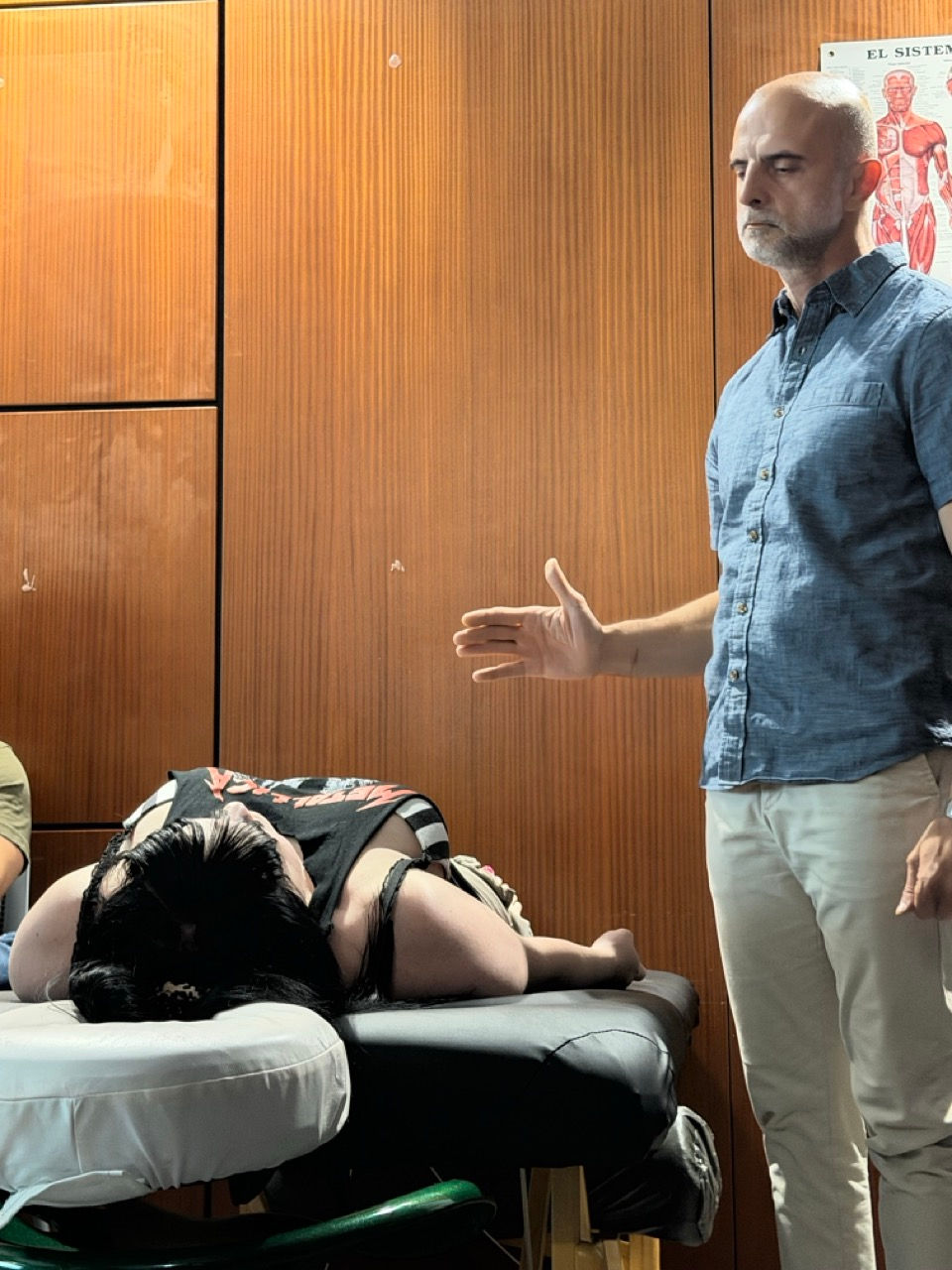
So then Dr. Edwards did a demonstration. He went through intake questions. He asked about lower back pain. He found the fascial line in front of the psoas and created friction on one point for 90 seconds to 3.5 minutes. The client described feeling the tissue "melt." Then their low back pain got better and he hadn't touched their lower back.
The "Amazing Scale" Instead of the Pain Scale.
I have to mention this because it genuinely delighted me. During the live demonstration on a client with lower back pain, Dr. Edwards didn't ask "how painful is this on a scale of 1 to 10?" He asked for a rating on an "amazing scale." As in, "how amazing does this feel?" where 7 out of 10 amazing is the target sensation he's looking for when he's found the right spot? Reframing the question changes the client's whole relationship to what's happening. Instead of bracing for pain, they're looking for something productive: A therapeutic sensation. That's a shift in how a session feels from the client's side of the table, and I'm filing it away.
Dr. Edwards has been integrating this method into his practice for two years since discovering it through the Institute for Anatomical Research. This is highly-researched, evidence-based, technical work. What today gave me was a new lens through which to appreciate what's happening in the fascial system. Every approach I've experienced through studying or as a patient ...John Barnes, Ruth Duncan, Chris Melmoth's Deep-MFR... and now this introduction to Stecco, has added a layer to how I think about fascia and how I work with it. They don't all agree on everything. The timelines differ. The vocabulary is different. The pressure entry points are different. But the underlying thread is the same: listen to the body, pay attention to the connective tissue, follow the lines, examine joint mobility,work with the whole person and their whole history instead of the spot that's screaming in the current moment.
Today gave me more understanding.
If you're in Las Vegas and dealing with pain that's stumped you, or that nobody has been able to explain, then book a session with me. And follow me on Instagram @luckygirliegirl for more on what I'm learning and my client results.


Comments